
Harry Heilmann Went Through the Front Door. Chuck Klein Used the Side Door
Long and consistent vs. meteoric but short

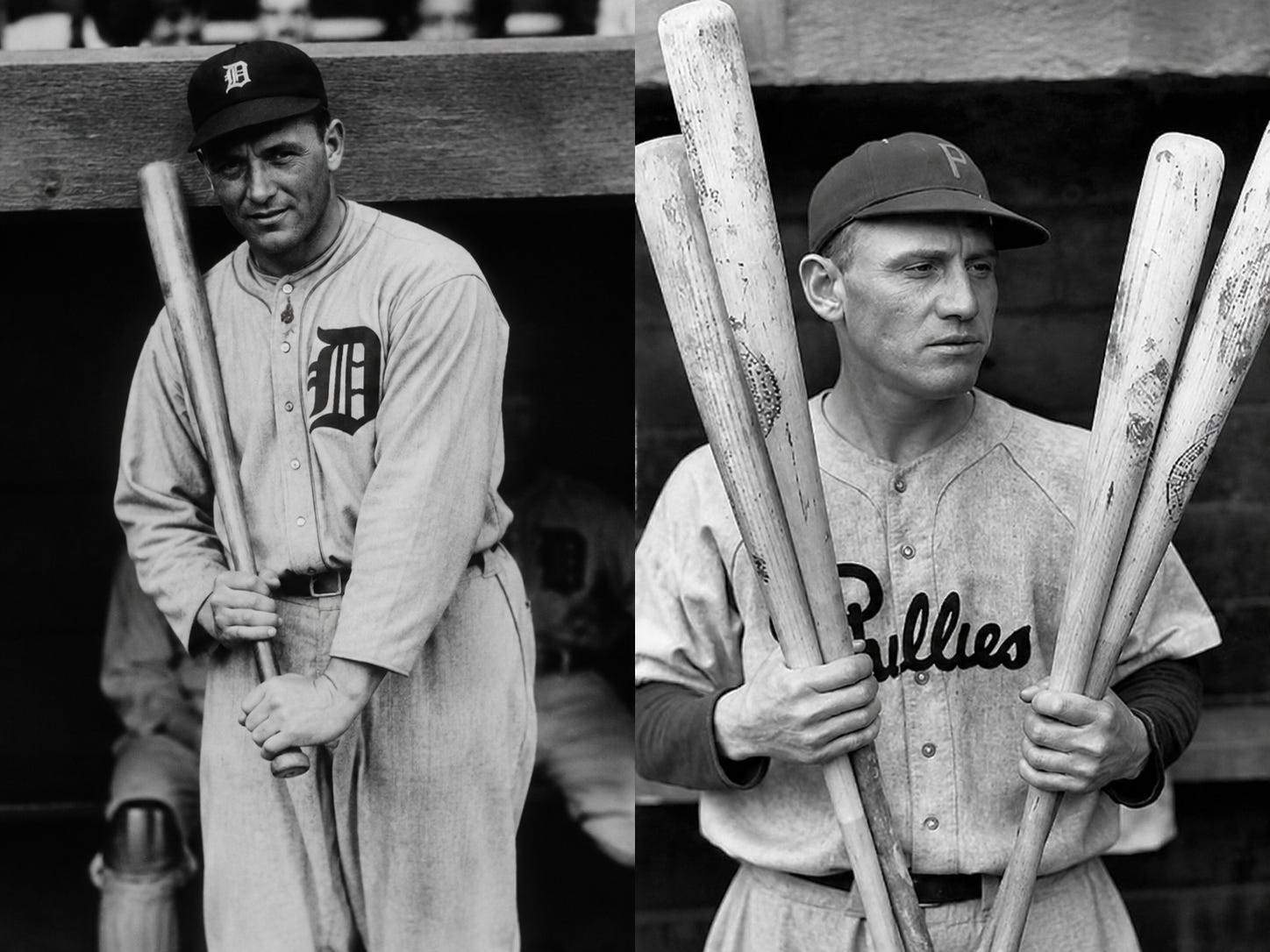
I’m intrigued with Baseball Hall-of-Famers whose name and team or teams I am aware of, but about whom I know little. HOFers Harry Heilmann and HOFer Chuck Klein are among the players enshrined in Cooperstown who I don’t know much about. I knew Heilmann played nearly his entire career with Detroit and that Klein won an MVP for the Phillies.
While both are worthy Hall-of-Famers, they had different ways of making history. Harry Heilmann’s consistent hitting prowess was his ticket to entrance while Chuck Klein’s case rested upon an extraordinary five-year period. Heilmann went into Cooperstown through the front door while Klein came in through the side door.
They were born ten years apart, Heilmann in August of 1894 and Klein in October of 1904. Although Heilmann began his career in 1914 which was 14 years before Klein, their playing careers overlapped in 1928-1930 and briefly in 1932 when Heilmann finally retired after 15 games. Heilmann was elected to the HOF in 1952, 20 years after his playing career ended, but sadly he did not live to see it as he died the year before at age 56. Klein got little support for the Hall from writers and was not inducted until 1979, 21 years after his passing.
Both were outfielders although Harry Heilmann was tried at first base according to Dan D’Addona’s SABR bio: “The Tigers realized the experiment with Heilmann at first base was not what they had hoped, and he returned to the outfield in 1921. It turned out better than anyone in the organization could have hoped for. Heilmann, Cobb and Veach — who led the AL in RBIs three times — formed one of the greatest outfields in baseball history.”
It’s always amazing to me that over his 24-year career, HOFer Ty Cobb never won a World Series. But at least he had the chance to play in three in a row! Over parts of 17 Tigers seasons, Harry Heilmann never played a World Series game. His nickname on the Tigers was “Slug”, and he did plenty of that!
Neither player was known as a defensive stalwart although Chuck Klein still holds the modern-era MLB record for outfield assists in one season with an incredible 44 in 1930. Klein’s 1929-1933 stretch when he averaged 6.4 bWAR totaled 32.3 bWAR which represented 70% of his career 46.3 bWAR. He did manage to play in one World Series, for the Cubs in 1935 when they lost to the Tigers (which was the first championship for Detroit, three years after Heilmann retired). Klein’s nickname the “Hoosier Hammer” was a nod to his roots in Indiana. By comparison, Heilmann never reached Klein’s single-season heights, but he produced nine seasons worth at least 4.5 bWAR and accumulated more than 70 career bWAR.
Among the sources for this post are the SABR biographies for Harry Heilmann and Chuck Klein and both are worth reading. I knew that Heilmann played with Ty Cobb but did not realize he followed HOFer “Wahoo” Sam Crawford in the Detroit outfield. Replacing a legend is always a tall order but Heilmann was more than up to the task. And it’s not as if Heilmann did not have an extraordinary run himself when from 1921-1927, he batted .394, .356, .403, .346, .393, .367, and .398 winning four batting titles along the way. By today’s standards those numbers look completely ridiculous and unattainable.
While Heilmann wasn’t the same kind of home run hitter as Chuck Klein, his career OPS of .930 ranks 43rd all-time and edges out Klein’s .922. Heilmann also tops Klein with his career OPS+ of 148 (48% above average), compared to Klein’s 137.
From the SABR bio on Klein: “He led all senior circuit outfielders in assists three times and set a modern major league record with 44 in 1930. Klein wasn’t a speed demon on the base paths, swiping only 79 bases in his career. However, he remains the only post-1920 player to lead his league in home runs and stolen bases in the same year, when he slammed 38 homers and stole 20 bases in 1932.”
Here’s how they compare side-by-side (from Stathead)
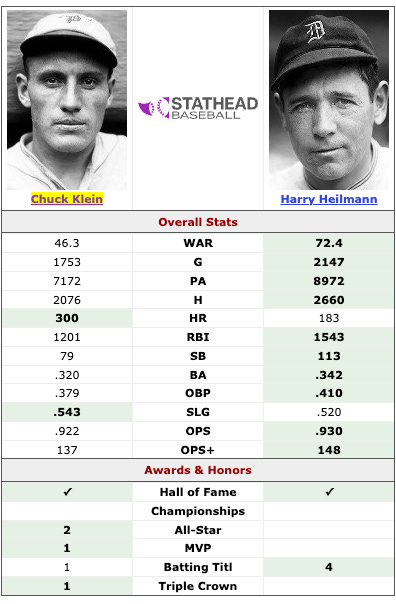
Keep in mind that Harry Heilmann retired before the first All-Star Game was played in 1933. While Klein’s .320 career batting average is notable (he’s 57th all-time), Harry Heilmann’s .342 career batting average is remarkable. Heilmann holds the third-highest career average for modern-era right-handed hitters. Imagine maintaining that average across a 17-year career! Over the past 20 years, there have only been 15 players (out or 40) to hit .342 or better as NL or AL batting champion.
Because both players had the unfortunate luck to play for teams that rarely contended for pennants, there are few signature moments known outside of Detroit (Heilmann) or Philadelphia (Klein) and they all happened during the regular season. Midway through his age 33 season in 1938, the Phillies abandoned their home, the cozy Baker Bowl, to play their remaining home games that season as a second tenant of Shibe Park (where the A’s played). Shibe was not as friendly to Klein to say the least and his production slipped and he was shipped to the Chicago Cubs in 1934. He still hit well in Chicago but compared to prior levels it was a downtrend, and during the 1934 season he tore a leg muscle which bothered him through much of 1934 and 1935. Klein returned to the Phillies in 1936 and had two more good but not great seasons. He never again reached anything close to what he was from 1929-33.
It’s been over 93 seasons since Harry Heilmann retired and 82 since Klein retired. Both were well-respected in their communities, Heilmann becoming a Tiger radio broadcaster for 17 years, and Klein after coaching four years for the Phillies, opened a tavern in central Philadelphia. Perhaps that’s the greatest value of Cooperstown—not simply preserving greatness but giving forgotten greatness another chance to be appreciated!
About the Author: Mark Kolier along with his son Gordon co-hosts a baseball podcast called ‘Almost Cooperstown’. He also has written baseball-related articles that can be accessed on Medium.com and Substack.com.
Good one! I wrote about Harry Heilmann in "Diamond Duels" and he had a knack for finishing strong. He won batting titles in 1921, 1923, 1925, 1927 and for the last two, he had a six-hit day in 1925 in a doubleheader, then a seven-hit day in 1927 to win the title. Wild, huh?