
When Being Really Good Every Year Becomes a Problem

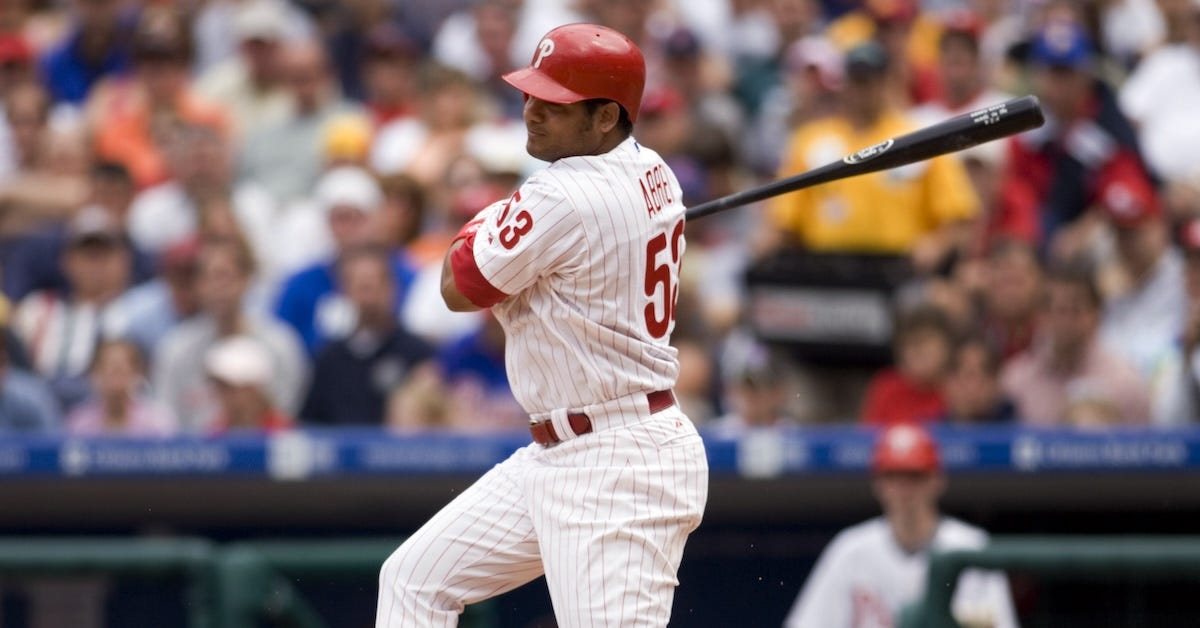
Bobby Abreu missed out on being elected to the Hall of Fame on the most recent ballot. I’ve mentioned on our podcast how Abreu was very good at many aspects of baseball and because none of his individual stats jump out as being all-time great, he’s on the bubble as a HOFer. Having few flaws is not considered a core HOF asset. When you put it that way it’s understandable.
BOBBY ABREU’s Baseball-Reference line:

That’s a great career! Abreu just missed the 300HR/400SB club (HOFers Willie Mays & Andre Dawson, Barry Bonds, A-Rod and newly minted HOFer Carlos Beltran) and the 200HR/400SB club includes HOFers Henry Aaron, Reggie Jackson, Frank Robinson, Dave Winfield, Craig Biggio and Jeff Bagwell. Mike Trout is right there with them (404HR/214SB). Abreu is one of only five players in MLB history to have 288+ home runs with 400 SB (Bobby Bonds and his son Barry Bonds, HOFer Rickey Henderson, and Biggio).
Since Abreu won a Gold Glove (in a 2005 season in which he sported a -1.5 dWAR), and I (mistakenly) recall him being more than competent as a right fielder so given that, to me he seemed to have had it all. But a closer examination of Abreu’s dWAR shows a career negative 10.9. Yikes! That’s a lot. That big minus takes away from his overall career bWAR which would exceed 70 had he been merely an average defender. Phillie fans would be better able to tell me that what I think I saw with Abreu in the field and why it was not what they saw every day. That must be the case, right? Statistics don’t lie however, and Abreu’s exclusion from Cooperstown may be squarely rooted in his statistically poorly rated defense. That noted, Abreu is still a strong candidate for being unfairly overlooked because while he was a rock-solid performer with his bat, he was neither flashy nor loud. Abreu’s seven seasons of greater than 5.2 bWAR (three of them more than 6) are flashy and loud. And yet that noise fell upon deaf ears.
There is a paradox in baseball legacy that being consistently excellent can work against you.
Fans favor outliers. Voters remember spikes. Awards seem to gravitate toward extremes. But players who are merely great every single year without ever being the absolute best, often fade into the background of history. These are the players who finish fourth in MVP voting. Third. Fifth. They make All-Star teams quietly. They anchor lineups and rotations without demanding attention. They don’t dominate seasons—they dominate careers.
But for most of them, that’s not enough to gain entrance into Cooperstown.
Consistency lacks drama. It doesn’t produce a defining moment. There’s no single season you can point to and say, “That was it.” Instead, there’s a decade or more of quiet excellence that only becomes obvious when you step back and look at the whole picture.
Abreu never finished higher than 12th in MVP voting in any one season although he did receive MVP votes for seven of his 18 seasons.
Besides Bobby Abreu, comparatives for ‘good at many things’ as far as batters are concerned is a list of HOF bubble players. When it comes to players who’ve never won an MVP nor are in the HOF, (according to B-R.com) names we know and talk about are Bernie Williams, Dwight Evans, Garrett Anderson, Torii Hunter, Chili Davis, and Steve Finley. Those comps are interesting when factoring in defense since Bernie Williams, Garret Anderson and Chili Davis were also not known as great defensive players. Dwight Evans won eight Gold Gloves, Torii Hunter won nine, and Steve Finley five.
Bobby Abreu has exactly one Gold Glove award, one Silver Slugger, and only appeared as an All-Star twice. It feels to me like Abreu is an outlier more than any of the others because he could hit for power, average, steal bases (400 career steals) and managed a very high career on-base average (.395 with 10 seasons in which he had over a .400 OBA). Yet Abreu never had that year.
Hall of Fame voting doesn’t reward hindsight. It rewards memory
When ballots arrive, voters look for seasons that seem important. Years that grabbed headlines. What awards did they win? The consistently great are remembered as supporting characters rather than leads—even when the numbers say otherwise.
This is how a career becomes flattened. Ten elite seasons blur together. The lack of a singular peak gets interpreted as a lack of dominance. The steadiness becomes sameness. And sameness gets mistaken for adequacy.
The cruel irony is that these players often age better historically than their flashier peers. When the dust settles, the total value is undeniable. The advanced metrics love them. The context favors them. The comparison lists become uncomfortable for voters who already decided how they felt years ago. But by then, the narrative has already been calcified.
“They were good, not great.”
Except they were great—just not loudly. The Almost Hall of Fame is full of players who never had to be the best player in baseball because they were one of the best every single year. They weren’t dependent on one skill. They adapted. They evolved. They stayed valuable long after others flamed out.
And yet, when legacy is discussed, they’re remembered as complements rather than cornerstones.
Baseball says it values reliability. History says otherwise. Bobby Abreu is hoping his future will be different from history.
About the Author: Mark Kolier along with his son Gordon co-hosts a baseball podcast called ‘Almost Cooperstown’. He also has written baseball-related articles that can be accessed on Medium.com and Substack.com.
Well argued assessment. Here is my take: https://faithofaphilliesfan.blogspot.com/2022/01/the-bobby-abreu-conundrum.html?m=1
When I think of abreu, I always think of Lance Bergman’s and Brian Giles. If I had a hof vote, pretty sure abreu and Bergman would get em